 |
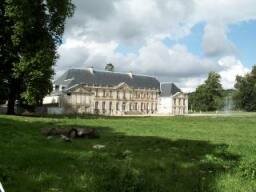
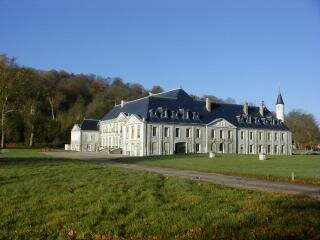
The monastery of "Notre Dame du Voeu" was founded in 1150. You can still see its medevial origins : beautiful rooms in Romanesque, Norman and Gothic styles (rooms of the lay brothers, room of the Chief Abbot). the church of the monastery was rebuilt after the 100 Years War and then demolished in 1810. The beautiful classical façade of the 18th century superimposed on the old one was inspired by the reform of Saint Maur. In the 19th century, the abbeywas sold to the state and became a chateau surrounded by a beautiful park created by Pierre Adrien Paris, who was a student of Lenotre. |
| In the second half of the 2Oth century, it became an industrial dairy. This industrialization of the beautiful abbey really took its toll seeing thaht it had already been neglected. In 1984, The town of Gruchet Le Valasse bought the property. With the help of a society, the Friends of the Valasse abbey, the town started to restore the buildings severely damaged by years of neglect. Now, the abbey has recovered its dignity and its place in history. It has a lively cultural life thanks to exhibits, concerts, symposiums, lectures and a light and sound show. | |
|
|
||
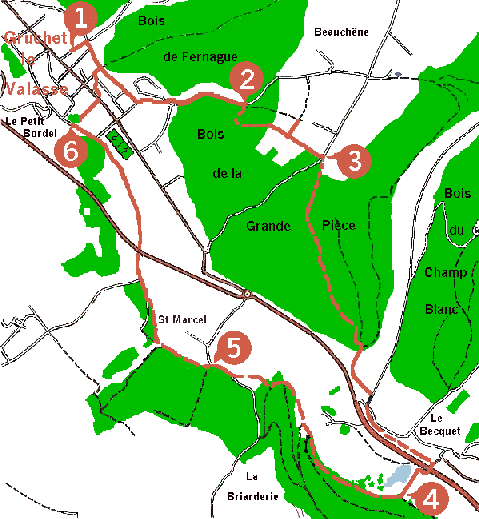
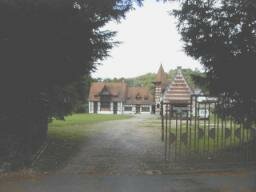
| 1) From the town hall of Gruchet le Valasse, go up to the right on Dr Gernez Street (at the intersection on left, you will see the outbuildings of the chateau which was destroyed in 1976). On the right, take President Coty Street, walk along Thomas Beckett Church, then to your left, take Beauchêne Street. Go across the roundabout and go up towards Beauchêne walking along the woods of "La Grande Piece". |
|
|
|
|
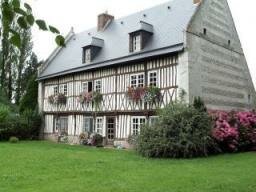
2) Halfway up, take the path through the woods, on your right. When you reach a vine covered building, you can go to the left to take a look at the XVIth Manor of Beauchêne (private property). | |
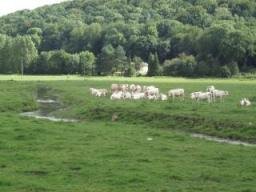
| 3) Cross the road and take the stone covered path that goes into the woods. At the fork, go right. You will walk by a former quarry where the the monks got the stone to buid their monastery. At the bottom of the hill, turn right and go out of the woods (You will see the Valley of Commerce) and continueon the small road that goes under the Railroad. tutn left along a meadow and follow the path which is parallel to the road. Walk on top of the embankment (former Road CD173) and at the intersection, go across road D173, but be careful ! Follow the path and go across two bridges : Le Becquet and La Rivière Noire. |
|
|
|
|
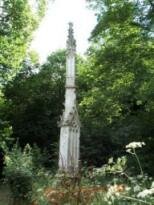
4) To the right, take the path between the woods of La Cote and the former park of the abbey. You will walk by a ridge ornament from the lantern tower of the former abbey (put there after the destruction of the latter). Walk along the abbey, the pony club and take the path to your left. On your way you will see several 100 years old trees (2 plane trees and 1 ash tree). Go first by the guard's house, then by another house, take the payh to the right between the fences. Take the road to the right. | |
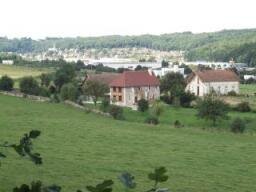
| 5) Take the first path to the left, called Path of the Monks, (chemin des Moines in French) which turns immediately to the right (panorama of the Commerce Valley, the Saint-Marcel farm and its former chapel where the monks lived while the Abbey was being built). Keep on going down and pass, on your left, Corneville Street, go under route D487, cross the railroad tracks at the crossing and continue on the road which goes along the Bolbec river, then into the Saint-Marcel Street. |
|
|
|
|
6) Right after no. 66 in that street, on your right, take the Stanislas Capelle and Fauquet Lemaitre lanes. Cross the street, cross the parking lot in diagonal and follow first on the right then on the left the Henry Ferric Street. Go up the street of the Cross, turn left, walk along the church and you will reach the Town Hall where you started. | |